Few market positions are permanent. New technology, shifting customer expectations, and new entrants keep reshaping markets, and the firms that stop adapting tend to lose ground they spent years building. Business history has plenty of once-dominant names that rested on their record and paid for it, and plenty of others that reinvented themselves in time.
Innovate or Become Obsolete
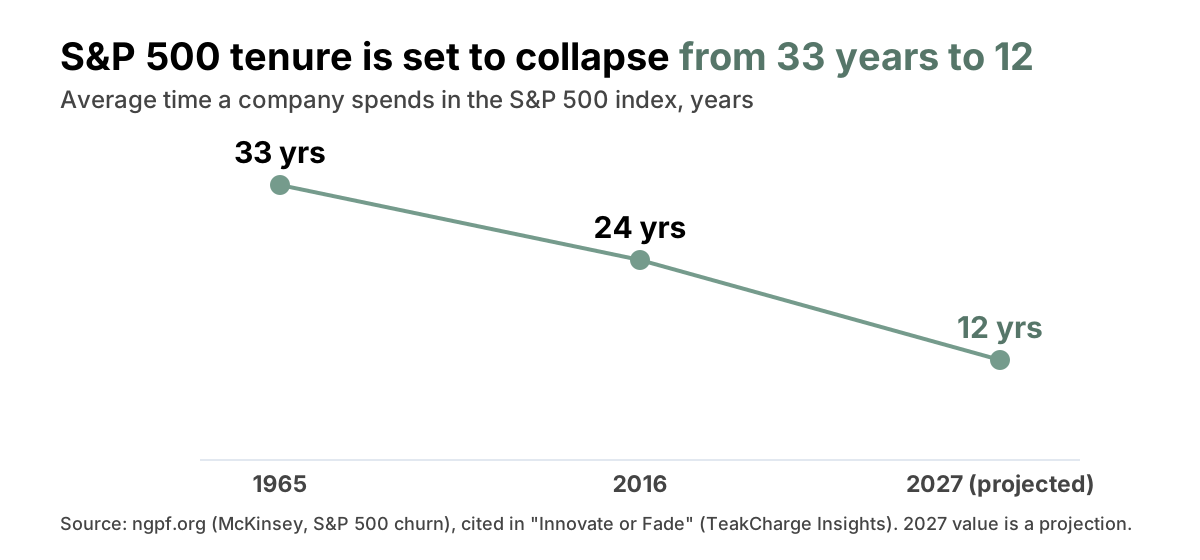
For business leaders, the message is clear: innovation is not optional. A striking data point comes from the evolving tenure of corporations in the S&P 500 index. In 1965, the average company on the S&P 500 could expect a 33-year run in the index; by 2016, that average lifespan had narrowed to just 24 years, and late-2010s research projected it would shrink toward just 12 years by 2027. This trend reflects an acceleration of competitive turnover: companies that fail to reinvent themselves are replaced by newer rivals at an ever-faster pace. For many long-established firms, the cost of standing still is the end of the business itself.
Look at the cautionary tale of Blockbuster Video. In 2004, Blockbuster was at its peak with 9,000 stores worldwide, generating $5.9 billion in revenue. Yet just six years later, this former industry giant filed for bankruptcy in 2010 as streaming upstarts like Netflix transformed how consumers accessed entertainment. Blockbuster failed to adapt its business model to the digital era, and its brick-and-mortar advantage became a liability. The rapid downfall of such a dominant company underscores that past success is no guarantee of future survival if a company resists change. What's true in entertainment has proven just as true in transportation (think of taxi companies pre- and post-ride-hailing apps) and in retail (many traditional retailers have struggled or collapsed in the face of e-commerce). The lesson: no matter the industry, refusing to innovate invites irrelevance.
Case Study: A Tale of Two Companies, Fujifilm vs. Kodak
Eastman Kodak and Fujifilm were direct competitors for most of the 20th century, each renowned for its film and camera products. When the digital revolution disrupted their core business, their responses could not have been more different, and so were the outcomes.
Kodak, an American pioneer founded in 1888, actually invented the first digital camera in 1975 but feared it would cannibalise its film business. Clinging to its profitable film sales, Kodak was slow to embrace digital photography. As a result, the company's fortunes steadily declined in the 2000s. In January 2012, Kodak filed for bankruptcy, ending an era in which it had once dominated 90% of the U.S. film market. Its late attempts to catch up, including a belated foray into digital cameras and even a dubious cryptocurrency project called "KodakCoin", did little to reverse the slide. Kodak is often cited as the classic example of a great company that failed to adapt and paid the ultimate price.
Japan's Fujifilm (founded in 1934) faced the same market upheaval of digital photography, but responded with aggressive innovation and adaptation. Under CEO Shigetaka Komori, Fujifilm acknowledged early on that its traditional film business would not survive the digital wave. The company took dramatic steps to reinvent itself. Fujifilm downsized legacy operations and then redeployed its deep technological assets into new domains. The company had expertise in chemical coatings and imaging technology from decades of film R&D; Fujifilm applied this know-how to expand into pharmaceuticals, healthcare, and cosmetics. One famous example is Fujifilm's line of anti-aging skincare products called Astalift, which grew out of chemicals originally developed to prevent photographic prints from fading. Similarly, Fujifilm built a substantial healthcare division (producing digital X-ray systems, diagnostic equipment, even vaccines and biopharmaceuticals) by repurposing its scientific research capabilities.
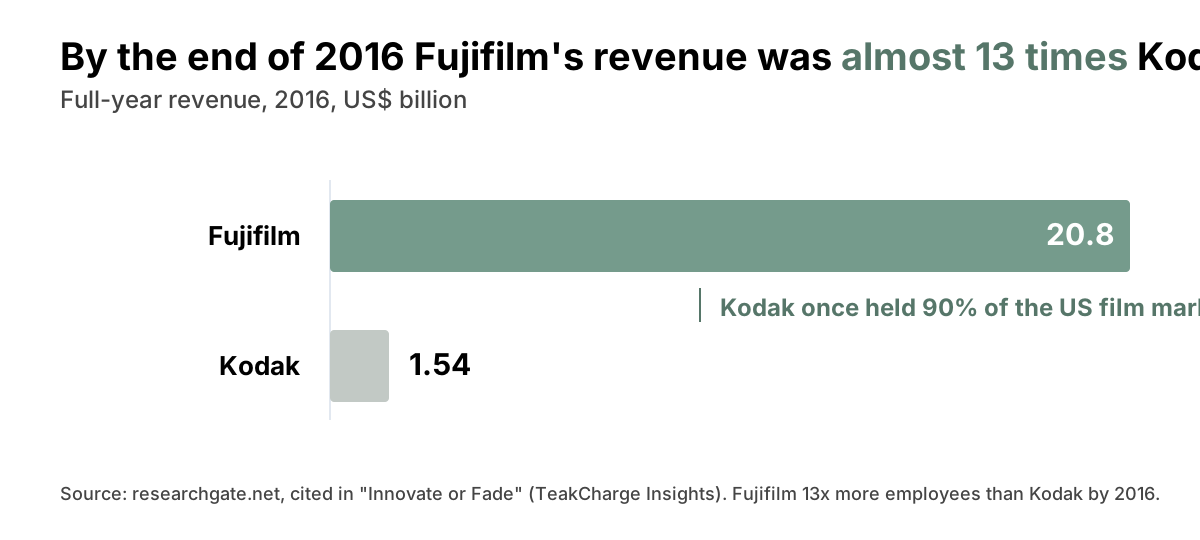
The results of Fujifilm's innovation drive have been substantial. By the end of 2016, roughly a decade after digital cameras went mainstream, Fujifilm's revenue was almost 13 times that of Kodak ($20.8 billion vs. $1.54 billion). Fujifilm also had 13 times more employees than Kodak by that date, reflecting its growth into new businesses while Kodak shrank. Today, Fujifilm is a diversified technology company; as of 2017, less than 1% of its profit came from traditional film products, with the vast majority generated by new ventures like healthcare imaging and cosmetics. In fact, Fujifilm's foray into instant cameras (the Instax line) found an unexpected niche and became a booming success in the 2010s, even as digital photography matured. As of the late 2010s, Fujifilm's annual revenues have hovered around $20 to 21 billion, a marker of a company that not only survived a disruptive innovation but transformed itself and grown.
By contrast, Kodak emerged from bankruptcy as a much smaller, less significant player, focused mainly on commercial printing and chemicals. In the 1960s, Kodak's revenues were 10 times larger than Fujifilm's, but half a century later Fujifilm is the one flourishing. This case study highlights how innovation is critical for long-term success. Fujifilm had the foresight and willingness to pivot boldly; Kodak did not. The financial and operational outcomes speak volumes: one company now stands as an innovation success story, while the other serves as a warning that even market leaders can become obsolete if they resist change.
The Payoff of Innovation
Adapting and innovating isn't just about avoiding failure, it's a path to superior performance. Numerous studies have shown that companies which prioritise innovation tend to outperform their peers financially. For example, stock indexes that track highly innovative companies find that these firms generate higher stock market returns in the long run relative to their benchmarks. In other words, innovators often deliver greater value to shareholders than more stagnant companies. McKinsey research similarly finds that the most innovative firms achieve total shareholder returns well above their industry medians over time. Innovation can drive new revenue streams, improve efficiency, and open up markets, all contributing to stronger financial results.
Innovation also has tangible operational benefits. A classic metric is the share of revenue coming from new products or services introduced in the past few years. Top innovators like 3M famously set targets (e.g. 30% of revenue from products launched in the last 4 years) to ensure a steady pipeline of new offerings. The payoff is evident: one analysis found customer-obsessed (highly innovative) companies were four times more likely to grow their revenues by 10%+ year-over-year compared to less innovative firms. Innovative companies can better attract and retain customers through fresh solutions, streamline processes with new technology, and adapt to changes faster, giving them a competitive edge on both growth and profitability.
On the flip side, the cost of the "do nothing" approach can be large. Economists often refer to the "cost of inaction": for example, failing to invest in a promising innovation today could mean missing out on a market worth billions tomorrow. A striking data point: a study by Innosight noted that half of S&P 500 companies may be replaced in the next 10 years if current churn rates hold. The companies that get replaced will largely be those that didn't move fast enough to reinvent their business models. For business leaders, the implication is that investing in innovation (whether through R&D, partnerships, or new ventures) is not a luxury, it's increasingly a necessity for durable market position. The ROI of innovation can be measured in staying power and relevance, not just immediate dollars.
Key Innovation Trends Shaping Global Business
Innovation can take many forms, but four trends are driving most of the success across industries worldwide today: digital transformation, artificial intelligence, sustainable innovation, and customer-centric strategies. Business leaders should pay attention to all four; each represents a significant opportunity and, if ignored, a real threat.
Digital Transformation: Reinventing Business in the Digital Age. Digital transformation refers to integrating digital technology into all aspects of a business, from operations and processes to customer experiences and business models. It's not just about adopting new tech for its own sake, but about using technology to drive efficiency, value, and growth. In recent years, virtually every industry has seen a surge in digital initiatives, a trend accelerated by the COVID-19 pandemic. Global spending on digital transformation reached $1.85 trillion in 2022, up 16% from the previous year, and worldwide DX investment is projected to keep rising at a double-digit pace, approaching $2.8 to 3 trillion within a few years. This massive investment reflects the priority businesses place on going digital. However, digital transformation is challenging, many efforts fail to meet their objectives due to issues like employee adoption, outdated processes, or unclear strategy. One study found only 35% of companies succeeded in achieving their digital transformation goals in 2021 (up from 30% in 2020, showing slight improvement). The companies that do get it right reap rewards: digital leaders have been shown to outperform laggards in metrics like time-to-market, cost efficiency, and customer satisfaction. For example, 84% of executives at top-performing companies say their digital investments have improved profitability. Successful digital transformation often involves cloud migration, modernising IT infrastructure, automating workflows, and using data analytics to guide decisions.
Artificial Intelligence and Automation: From Data to Competitive Advantage. AI and machine learning have emerged as major innovation fronts across industries. AI allows companies to use big data and computing power to make smarter decisions, automate routine tasks, and even create new products and services. Adoption of AI has accelerated rapidly worldwide. In 2017, only about 20% of companies had incorporated AI in at least one business area; today roughly 50% of companies are using AI in some form, a figure that doubled in just five years. Surveys indicate that as of 2023, over 80% of global enterprises are either using or exploring AI solutions in their operations. From chatbots handling customer service inquiries, to AI algorithms optimising supply chains, to advanced analytics predicting maintenance needs, AI applications are proliferating. The financial impact of AI can be significant. AI-driven process automation can cut processing times by 30 to 50% in some back-office functions, and personalised AI-powered marketing can substantially boost conversion rates. 83% of businesses now place AI as a top strategic priority for their organisation's future. Those who fail to invest in AI risk falling behind more data-savvy competitors. That said, AI adoption must be paired with the right talent and change management, many firms cite lack of skilled personnel and data quality issues as barriers.
Sustainable Innovation: Embracing Sustainability as Strategy. Innovation today is not only about tech and profits, it's also about sustainability and purpose. Sustainable innovation involves developing new products, services, and processes that deliver business value while also benefiting the environment or society. With rising global concerns about climate change, resource scarcity, and social responsibility, sustainability has moved from a "nice to have" to a core strategic priority for many corporations. This shift is being driven by stakeholders across the board: consumers, investors, and regulators are all expecting companies to operate more sustainably. In a Nielsen survey, 73% of global consumers said they are willing to change their consumption habits to reduce environmental impact. It's no surprise that businesses are responding by innovating in areas like renewable energy, circular economy, sustainable supply chains, and green products. What's crucial for business leaders to recognise is that sustainability and innovation go hand-in-hand. A study by BCG found that companies which embed sustainability into their business models are 1.4 times more likely to achieve innovation breakthroughs, leading to unique new products and operational efficiencies. We see this in automakers investing in electric vehicles and battery technology, in consumer goods firms inventing biodegradable packaging, and in food companies creating plant-based protein products. Pursuing sustainability can also improve the bottom line. According to McKinsey, adopting sustainable practices can reduce costs and boost operating profits by up to 60% through efficiencies like energy saving and waste reduction. Investors are also rewarding sustainability: by 2020, 85% of large investors considered environmental, social, and governance (ESG) factors in their decisions, channeling capital towards sustainable innovators. A notable example is the rise of the renewable energy industry. In 2023, China invested over $546 billion in renewable energy development, more than half of the global total for that year, demonstrating how major economies are betting on sustainable innovation.
Customer-Centric Strategies: Innovating Around the Customer. Customer-centric innovation means putting the customer's needs, experiences, and feedback at the centre of product development and service design. In practice, this could involve using data analytics to personalise offerings, redesigning a mobile app to be more user-friendly, or even rethinking an entire business model to eliminate pain points for customers (as fintech startups have done in banking). The importance of customer-centric strategies has never been higher. Studies show that 73% of customers say a good experience is the most important factor in their purchase decisions, outranking price or product quality for many consumers. In the age of social media and instant reviews, a single poor experience can drive a customer to competitors, whereas consistently great experiences build loyalty and advocacy. The business impact of focusing on customer experience (CX) is quantifiable. According to analysis compiled by Zendesk, customer-centric brands report profits that are 60% higher than brands that neglect CX. Firms that invest in superior customer service and engagement also tend to see higher retention and lifetime value. 90% of organisations now say they have made CX their primary focus in business strategies, and 80% of executives plan to increase customer experience budgets in the next year.
Conclusion: What Adaptation Requires
The evidence is overwhelming: innovation is the engine of long-term business success, and companies that don't adapt will inevitably be left behind. Whether it's embracing new technologies like AI and digital platforms, reimagining products with sustainability in mind, or continuously improving the customer experience, businesses must be willing to evolve. The financial and operational impacts of innovation are profound: more agile companies not only avoid obsolescence but often capture more market share and profit. Fujifilm and Kodak are the clearest illustration: the company that innovated survived and prospered, and the one that resisted change faded into history.
The pattern across these cases is consistent. Companies that build a culture of innovation, encourage experimentation, invest in R&D, and stay attuned to emerging trends tend to sustain their market position longer than those that do not. The data points worth tracking are concrete: the percentage of revenue coming from new offerings, innovation spending relative to industry peers, and customer feedback as a source of new ideas. In a globally connected market, innovation happening in one region can affect industries elsewhere quickly; no company operates in isolation.
The choice for established companies is stark: innovate or fade away. It is also a chance to reinvent, to solve meaningful problems in new ways, and to write the next chapter of a company's story. Darwin's insight applies just as well in business: the companies that survive are the ones most responsive to change, not the strongest or the biggest.