Conventional wisdom holds that protectionism and tariffs harm economic growth, especially for developing regions. The data says otherwise: the current wave of protectionist measures, particularly those targeting China, is accelerating industrialisation and economic development across South Asia and Southeast Asia (SASEA).
Protectionism as a Catalyst for Investment Diversion
The US-China trade fight has pushed investment into SASEA, and the size of the move is now measurable.
From China to Southeast Asia: The Great Redirection. The UNCTAD numbers now show the redirection plainly. On UNCTAD's like-for-like measure of gross inflows, South-East Asia drew $222 billion in 2024 and $244 billion in 2025, while China drew $116 billion and then $105 billion. That is a ratio of better than two to one, and China's inflows have now fallen for three consecutive years. In 2025 South-East Asia overtook East Asia to become the largest recipient subregion in developing Asia, a first, and it happened while global FDI rose 6% to $1.6 trillion. The investment that previously would have flowed to China is now finding new homes across the region, with Vietnam and Indonesia the clearest beneficiaries, and India, on a separate South Asian track, posting a 44% rise in inflows in 2025.
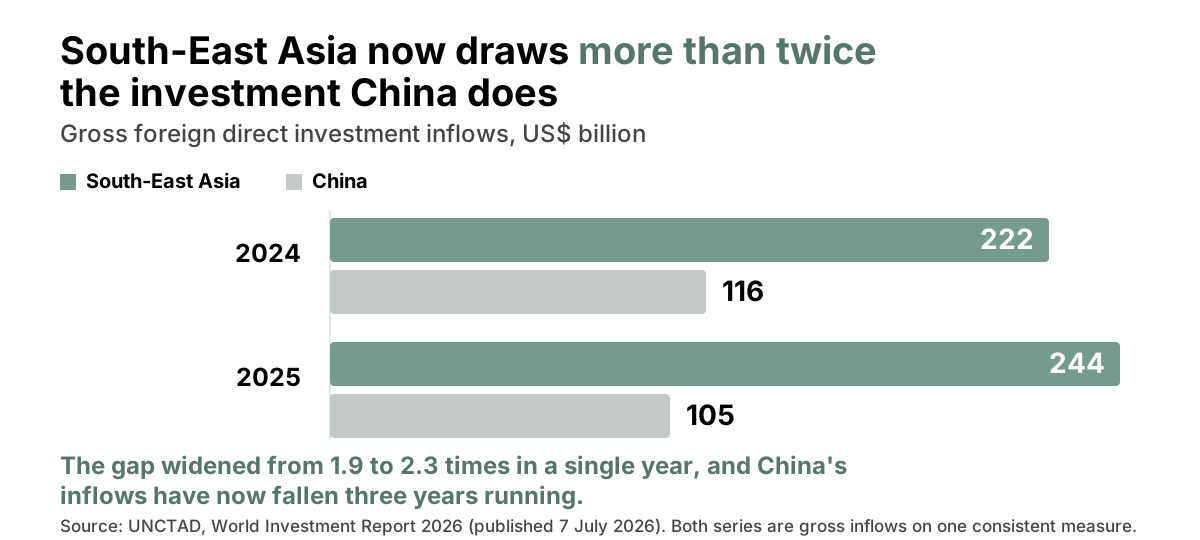
One caution on the numbers, because it changes how they should be read. Comparisons of this kind are routinely built from two different measures, gross inflows on one side and a net balance-of-payments figure on the other, which can overstate the gap several times over. The figures above are gross inflows on both sides, from a single source, which is why the ratio here is narrower than the ones usually quoted. The narrower ratio is the honest one, and better than two to one is still a wide gap.
"China+1" Strategy: Accelerating Industrial Diversification. Tariffs on Chinese exports are altering corporate strategy, with companies worldwide implementing what analysts call "China+1" or even "China+3" strategies. This approach involves maintaining some production in China while establishing additional manufacturing capacity in alternative locations, primarily SASEA countries. Bain & Company, DBS, and the Angsana Council name this shift directly as a structural driver of the region's outlook: their Navigating High Winds: Southeast Asia Outlook 2024-34 report projects SASEA's six largest economies to outpace China in both GDP and FDI growth over the coming decade, citing the China+1 realignment alongside domestic demand as the two forces behind it. That is where the new factory investment is going.
The "Flying Geese" Effect: Tariffs as Pro-Globalisation
Tariffs are spreading manufacturing across more countries rather than shutting trade down. For decades, China's vast internal market and government policies created powerful incentives to concentrate manufacturing within its borders. This concentration slowed the natural spread of industrialisation to neighbouring countries, a pattern economists call the "flying geese" model of development, where manufacturing naturally migrates to lower-cost locations as economies develop. Tariffs on Chinese goods are now effectively reversing this concentration, pushing manufacturing to spread across more countries. Without tariffs and de-risking policies creating pressure to diversify, SASEA countries may well have had to wait decades more before cost pressures would have finally forced Chinese firms to invest abroad.
Chinese Companies' Outward Investment. It is not just Western companies relocating production to SASEA. Chinese manufacturers themselves are establishing operations in SASEA countries to circumvent tariffs. Companies like BYD, Huawei, and Xiaomi have announced plans to invest in SASEA to avoid tariffs and find new growth opportunities as China's domestic economy slows. Vietnam takes the largest share, and Malaysia and Thailand are also important destinations for Chinese FDI. China is now out-investing Western countries in Southeast Asian manufacturing in some sectors, batteries most of all.
Country-Specific Benefits of Protectionist Realignment: SASEA's Diverse Development Pathways
Each country is attracting a different slice of the work, on a different advantage.
Vietnam: The Prime Beneficiary. Vietnam has emerged as the clearest winner from manufacturing relocation, with FDI rising by 5.4% year-on-year to $2.95 billion in February 2025. Both the United States and China invest there, each treating it as a crucial "swing state" in their regional competition. Vietnam's manufacturing sector has shown substantial growth, with its industrial production index for manufacturing reaching 183.4 in the third quarter of 2024, far exceeding both the baseline of 100 and other regional performers.
Indonesia: Using Resources for Industrial Development. Indonesia's abundant natural resources are attracting significant investment into processing industries. The country received approximately $33 billion in greenfield manufacturing FDI in 2023, much of which might previously have gone to China. Indonesia is successfully pressuring China to invest in its local battery supply chain, demonstrating how SASEA countries can use their market access to secure valuable technology transfers. This strategy is particularly effective in sectors like electric vehicle battery production, where Indonesia's nickel reserves (22% of global reserves) give it significant leverage.
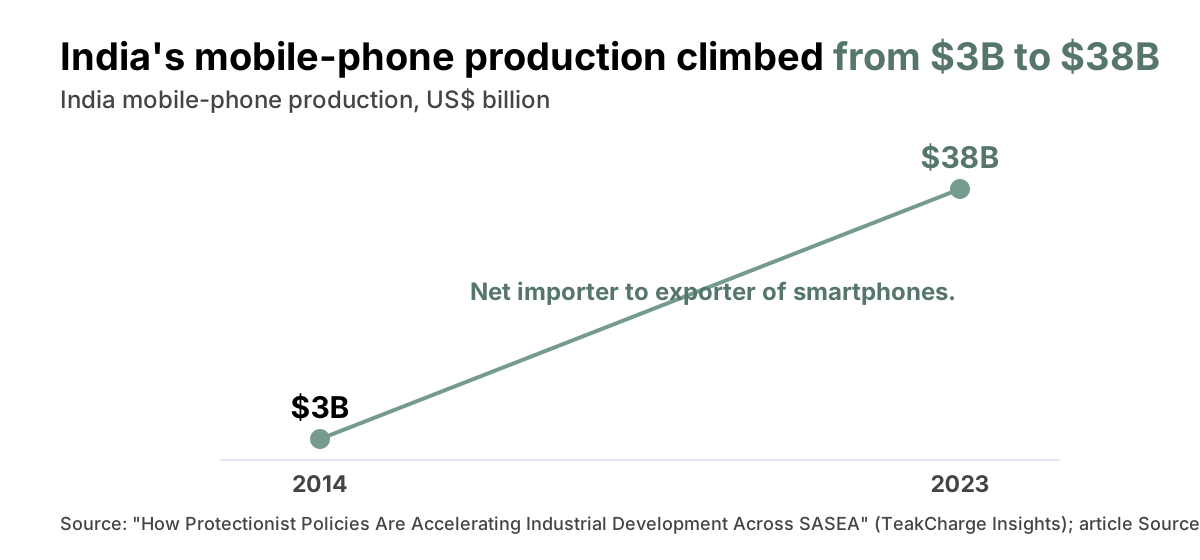
India: Scale and Technology Transfer. India's large domestic market and relatively low wages are attracting companies seeking alternatives to China. Apple's expansion of iPhone manufacturing operations in India exemplifies this trend, with the company redirecting production that would likely have remained in China absent current trade tensions. India's electronics manufacturing has shown substantial growth, with mobile phone production increasing from $3 billion in 2014 to $38 billion in 2023, transforming the country from a net importer to an exporter of smartphones.
Thailand: Balancing Protection and Chinese Investment. Thailand is trying to tax Chinese goods while keeping Chinese money coming. The Thai government is currently considering imposing a seven percent value-added tax on Chinese goods priced less than 1,500 baht (US$40) that are routed through Thailand's free trade zones to protect local businesses. This measure aims to curb the influx of low-cost products that have reportedly caused local manufacturers to reduce production by approximately 50 percent. At the same time, Thailand has benefited significantly from Chinese investment and technology transfer, which supports the country's ambition to transform into a regional EV hub. Direct investment from Chinese firms in Thailand was valued at $4.6 billion in 2023.
Malaysia: Investment Guarantees Despite Political Challenges. Malaysia has created a strong framework for attracting and protecting foreign investment through Investment Guarantee Agreements (IGAs). These agreements protect against nationalisation and expropriation, ensure prompt compensation, provide free transfer of profits and capital, and guarantee settlement of investment disputes. This framework has helped Malaysia attract more than 8,000 international companies from over 40 countries. Political instability cuts into that. Research found that political instability has a significant negative effect on FDI, with a 0.27% decrease in FDI for each unit increase in political instability.
Bangladesh: Manufacturing Growth Through FDI. Bangladesh has emerged as another significant beneficiary of manufacturing diversification, attracting the second highest FDI in South Asia as of 2021. The country has strategically positioned its manufacturing sector as a priority since independence, and foreign investment has been crucial for enhancing production. Opening to trade brought more foreign money in, spread across more manufacturing sectors. Bangladesh has little domestic capital of its own, so foreign money is what buys the plant, the jobs and the skills transfer.
Philippines: Liberalisation to Overcome Restrictive Barriers. The Philippines has historically maintained highly restrictive barriers to foreign direct investment, ranking as the third-most restrictive country out of 84 nations in the OECD's FDI regulatory restrictiveness index in 2020. The Philippines has since been opening up. These reforms include amendments to the 85-year-old Public Service Act, the 30-year-old Foreign Investments Act, and the 20-year-old Retail Trade Liberalization Act. Manufacturing has emerged as the biggest FDI destination in the Philippines.
Singapore: Strategic Infrastructure Investment. Unlike other SASEA countries that can compete on labour costs, Singapore must position itself as a high-value hub within reconfigured supply chains. In response to increasing competition from advanced economies rolling out large subsidies for domestic production in strategic industries, Singapore has focused on investing in connectivity infrastructure. The ongoing construction of Changi Airport Terminal 5 and Tuas Port aims to significantly enhance Singapore's capacity and reinforce its status as a business and logistics hub. These investments have already attracted more multinational corporations to anchor their regional and global supply chain operations in Singapore.
Conclusion: Redefining Globalisation Rather Than Ending It
Tariffs and de-risking are spreading plant investment across Vietnam, Indonesia, India, Malaysia and Thailand instead of concentrating it in China. That is a wider production map, not a smaller one. By forcing diversification of manufacturing away from its heavy concentration in China, tariffs and other protectionist measures are accelerating industrial development across SASEA that might otherwise have taken decades. So some forms of protectionism spread development rather than concentrate it. SASEA countries have a window to build industrial capacity while the money is moving.
Call it what the UNCTAD numbers already show: South-East Asia at $244 billion of gross inflows in 2025, China at $105 billion, a first time this subregion leads developing Asia. For SASEA's 2.5 billion people, an accident of someone else's trade policy may be the fastest development on offer.
Which of these markets is ready for a commercial entry is a separate question, scored in the 22-market go-to-market scorecard, from the same public sources.