South and Southeast Asia together hold over 2 billion people. In 2023 India grew GDP by 7.2%, and Southeast Asia's economies are moving towards a collective $4.3 trillion by 2025, on the back of expanding middle-class demand, growing startup ecosystems, and rising foreign direct investment (FDI). For anyone planning APAC market entry, SASEA now sits alongside China and the established Southeast Asian hubs rather than behind them.
Each of these markets has its own rules, and none of them are easy to learn from outside. Most companies enter the region through Singapore. Its regulation is predictable, and its banks and trade agreements already reach across the region.
What follows is Singapore's own case, and how a business actually uses the hub.
The Rise of SASEA: A New Economic Powerhouse
What is SASEA? SASEA covers South Asia and Southeast Asia. Spanning countries like India, Indonesia, Vietnam, Bangladesh, Thailand, and the Philippines, those economies are growing fast, and they are industrialising and digitising at once. SASEA is not a formal bloc. It is a planning grouping, not a treaty.
Unprecedented Growth and Economic Indicators Start with the population: India (1.52B), Indonesia (294M), and Pakistan (275M) are projected to have some of the largest populations by 2030, creating an expansive consumer base and workforce. With projected median ages in India (30.8), Vietnam (35.7), and Indonesia (31.8), the region remains young and positioned for industrial and digital growth.
- India's GDP grew 7.2% in 2023.
- Southeast Asia's collective GDP is expected to reach $4.3 trillion by 2025, driven by strong industrialisation and consumption
- Vietnam and Indonesia are emerging as key manufacturing hubs, attracting record foreign investments in sectors like electronics, semiconductors, and renewable energy
- The region is home to over 2 billion people, with a growing middle class that is fueling demand for goods, services, and technology
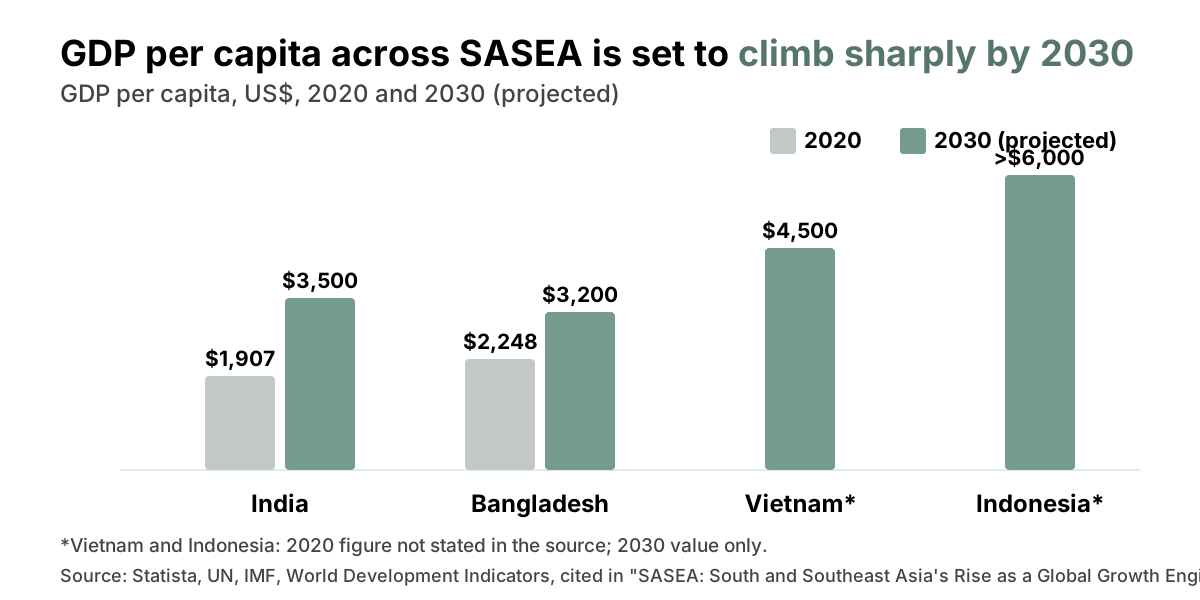
Rising incomes are set to transform consumer spending power. India's GDP per capita is expected to grow from $1,907 in 2020 to $3,500 by 2030, while Bangladesh will surge from $2,248 to $3,200. Southeast Asia is seeing even greater jumps, with Vietnam reaching $4,500 and Indonesia surpassing $6,000 by 2030. That is a middle class with money to spend, on the pattern China set in the 2000s.
Trade volumes are rising, and the region keeps adding trade agreements. The Regional Comprehensive Economic Partnership (RCEP), the world's largest trade pact, has enhanced cross-border trade within the region, making SASEA a more attractive destination for multinational corporations.
Digitalisation and Urbanisation: The Next Growth Drivers Digital adoption and urbanisation are now doing as much work as the traditional industries:
- Southeast Asia alone had over 460 million internet users in 2023, and India is adding millions of new digital consumers each year.
- A booming fintech and e-commerce market, with startups in Indonesia, India, and Vietnam attracting billions in venture capital funding.
- Smart cities and infrastructure investments reshaping urban landscapes, as governments across the region commit to modernising transportation, energy, and digital infrastructure.
By 2030, internet penetration across SASEA is expected to reach over 75% in India, 85% in Indonesia, and 90% in Vietnam, a dramatic leap from 2020 levels. Those users are what the fintech and e-commerce businesses are chasing.
Singapore: The Gateway to SASEA
A Strategic Location for Trade and Business Expansion Singapore sits in the middle of the region, which makes it the practical base for expanding across it. As a key maritime and aviation hub, Singapore connects global supply chains with the fast-growing consumer and industrial markets of South and Southeast Asia. Its top-ranked port and logistics infrastructure enable efficient trade, making it an essential gateway for companies operating across multiple countries in the region.
A Business-Friendly and Stable Economy Unlike many emerging markets, Singapore is politically stable and its regulation is predictable. Ranked among the world's easiest places to do business, Singapore's pro-business policies, tax incentives, and free trade agreements (FTAs) make it highly attractive for companies looking to set up regional headquarters. Key advantages include:
- Ease of Doing Business: ranked consistently among the top in the world.
- Low Corporate Tax Rates: a flat 17% tax rate, with incentives for startups and foreign investors.
- Strong Legal Framework: protecting intellectual property and contract enforcement.
A Leading Financial and Investment Hub Singapore is where the region's venture capital, private equity and fintech money sits, and where most SASEA deals get financed.
- Singapore attracts over $100 billion in FDI annually, making it the top destination for foreign investment in Southeast Asia.
- The city-state is home to over 200 banks and financial institutions that handle cross-border transactions across SASEA.
- Singapore-based venture funds back startups across the region.
How Businesses Can Use Singapore to Enter SASEA
Here is how companies actually use it:
1. Market Entry and Expansion: Companies can establish regional headquarters in Singapore and enter more than one SASEA market from there. From here, they can:
- Use Singapore's free trade agreements to reduce import and export costs.
- Use government-backed incentives for foreign businesses expanding into Southeast Asia.
- Hire local people who already know each market's rules.
2. Financial and Investment Opportunities: Singapore's strong financial system provides access to venture capital, private equity, and institutional funding to scale operations in SASEA. Companies can:
- Secure funding from regional and global investors.
- Use Singapore-based financial institutions for efficient cross-border transactions.
3. Scaling Digital and Technology Businesses: For tech startups and digital businesses, Singapore provides an ideal testbed before scaling into SASEA markets. Companies can:
- Pilot innovations in a developed regulatory environment before expanding into emerging economies.
- Utilise Singapore's fintech and AI-friendly policies to build scalable tech solutions.
Conclusion: The Future of SASEA and Singapore's Role in It
For companies entering SASEA, Singapore is still the strongest base available, and it is where they will run the business from, not just where they enter. The businesses building a presence in SASEA now are establishing the market knowledge and local relationships that will be harder to replicate once the region's growth is already priced into asset values.