Grant figures, eligibility thresholds, and scheme availability are current as of July 2026. Several caps and co-funding rates moved at Budget 2026; where a scheme's exact current figure could not be confirmed from an official source, it is marked below rather than guessed. Verify current amounts and status directly with Enterprise Singapore, MAS, IMDA, or the relevant agency before relying on this information.
As of July 2026
- Startup SG Tech: up to SGD 400,000 (POC) and SGD 800,000 (POV).
- Startup SG Founder: SGD 20,000 to SGD 50,000, 1:1 co-match.
- PSG: up to 50% of eligible costs, capped at SGD 30,000, including pre-approved GenAI tools.
- MRA: up to 70% for SMEs from 1 April 2026, capped at SGD 100,000 per new market.
- EDGE (MRA + PSG + EDG) is planned for the second half of 2026. The three schemes stay open until it launches.
- MAS AIDA, ESG FinTech and FSTI Innovation Acceleration windows through 16 July 2026 have passed. Check MAS for any successor.
- Most Enterprise Singapore schemes require at least 30% shareholding by Singapore citizens or PRs. Registration in Singapore is not enough.
- Figures move. Confirm on the official page before you apply.
| Scheme | Agency | Ceiling or rate | Local-ownership gate | Window as of July 2026 |
|---|---|---|---|---|
| Startup SG Tech | Enterprise Singapore | SGD 400,000 POC / SGD 800,000 POV | 30% | Open |
| Startup SG Founder | Enterprise Singapore | SGD 20,000 to SGD 50,000, 1:1 | 51% of issued shares | Open, company under 6 months |
| Startup SG Equity | Enterprise Singapore / SEEDS / SGInnovate | Co-invest up to SGD 8m deep-tech / SGD 2m general tech | Confirm current rules | Open; +SGD 1bn at Budget 2026 |
| MRA | Enterprise Singapore | 70% SME, SGD 100,000 per new market | 30% | Open until EDGE |
| EDG | Enterprise Singapore | 50% SME / 30% non-SME | 30% | Open until EDGE |
| PSG | Enterprise Singapore | 50%, cap SGD 30,000 | 30% | Open until EDGE; GenAI on the pre-approved list |
| AIDA (FSTI 3.0) | MAS | 30%, cap SGD 500,000 | No shareholding rule published | Window to 16 July 2026, now passed |
| ECI | DISG | 70% consultancy, cap SGD 105,000, plus cloud credits | No shareholding rule published; staffing gates | Open |
| EIS (tax, not a grant) | IRAS | 400% deduction on up to SGD 50,000 AI spend, YA 2027 and 2028 | No shareholding rule | Criteria were due 30 June 2026; check IRAS |
| SFEC | SkillsFuture / Enterprise Singapore | SGD 10,000 credit | No shareholding rule; 3+ local employees | Current tranche ends 30 November 2026 |
Singapore ranked 4th in the 2024 Global Innovation Index and first on the 2025 CTA Global Innovation Scorecard. The practical problem is not the existence of grants. It is which scheme a given company can actually apply for. There are enough separate schemes here that the hard part is knowing which one you qualify for.
The country rose to 4th place globally in the 2024 Global Innovation Index (GII), marking its best performance in over a decade. In the 2025 Global Innovation Scorecard by the Consumer Technology Association (CTA), Singapore surpassed the US to rank as the world's most innovative country on that scorecard. Over SGD 30 billion has been allocated, and there are roughly 4,500 startups. Budget 2026 added to that base directly: an extra SGD 1 billion went into Startup SG Equity, extending it from early-stage deep tech into growth-stage companies, and several SME schemes had their co-funding rates raised.
The same government push now has a second target: getting established companies, not just startups, to adopt AI. Enterprise Singapore and IMDA have spent the last two years building the funding and delivery infrastructure for GenAI adoption inside ordinary SMEs and larger enterprises, and Section 5 below covers what is actually available.
One change to know before the scheme-by-scheme detail: Enterprise Singapore is merging MRA, PSG, and EDG into a single scheme called EDGE, planned for launch in the second half of 2026 and open to all Singapore businesses including non-SMEs. The three existing schemes stay accessible as described below until EDGE actually launches, but a business planning an application in the coming months should check whether EDGE has gone live first.
The sections below cover each scheme and who qualifies for it.
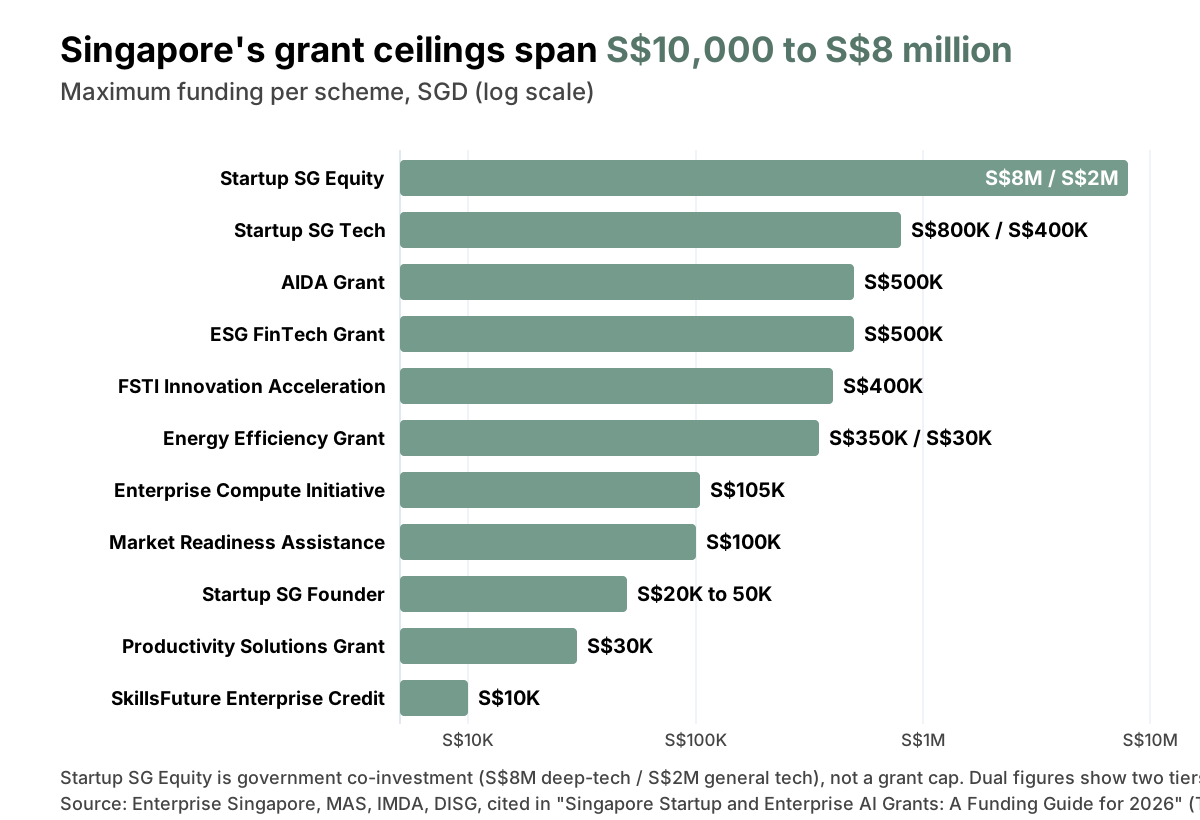
Table of Contents: 1. Government Grants for Startups in Singapore: Innovation & Early-Stage Funding 2. Business Grants for International Expansion & Growth in Singapore 3. Business Grants in Singapore for Productivity & Digital Transformation 4. Industry-Specific Grants in Singapore: Aviation, Agri-Food, Tourism & More 5. Government Support for AI Adoption by Enterprises and SMEs
Definitions
- Local shareholding: shares held, directly or indirectly, by Singapore citizens or Permanent Residents. A company can be Singapore-registered, staffed, and tax-resident, and still fail this test.
- SME, on most Enterprise Singapore schemes: group sales at or under SGD 100 million, or group headcount at or under 200.
- EDGE: the planned single scheme that absorbs MRA, PSG and EDG in the second half of 2026. Eligibility for EDGE has not been published.
- Grant versus co-investment versus tax deduction: Startup SG Equity is government money next to a private cheque, not a grant cap. EIS is a deduction on the tax return, not cash up front unless the cash-payout option applies.
1. Best Government Grants for Startups (Innovation & Early-Stage Funding)
(For R&D, prototype development, and commercialisation of innovative solutions)
- Startup SG Tech (Enterprise Singapore). Helps startups quickly develop and commercialise new, proprietary technologies. Two stages: Proof of Concept (POC) for testing early-stage ideas, and Proof of Value (POV) for validating proven technologies before market launch. Funding: Up to SGD 400,000 (POC) and up to SGD 800,000 (POV); awarded on milestone completion; figures unchanged since 2025. Eligibility: Registered in Singapore within 10 years; at least 30% shareholding held directly or indirectly by Singapore citizens or Permanent Residents; not a subsidiary of a larger corporate; group annual sales turnover ≤ SGD 100 million or group employment ≤ 200 workers. Requirements: Paid-up capital ≥ 10% of POC grant / ≥ 20% of POV grant. Apply: Two-stage application before project start via the Startup SG Tech webpage.
- Startup SG Founder (SSGF) (Enterprise Singapore). Supports first-time entrepreneurs with mentorship plus funding, with guidance from Accredited Mentor Partners (AMPs) in pitch training, investor/corporate networking, and secretarial/accounting support. Funding: SGD 20,000 to SGD 50,000 with 1:1 co-matching (revised from a 3:1 ratio in April 2024, unchanged since). Eligibility: Registered as a private limited entity in Singapore under 6 months; at least 51% of issued shares held by Singapore citizens or Permanent Residents; founders must be first-time entrepreneurs holding ≥30% equity, with a clean prior ACRA record. Requirements: No prior government funding for the same idea; co-matching paid-up capital 1:1. Apply: Through an AMP, who evaluates viability and endorses.
- Artificial Intelligence and Data Analytics (AIDA) Grant (MAS). Supports financial institutions and fintech startups developing or adopting AI and data-analytics solutions. The "valid until March 2026" window in the original guide was extended to 16 July 2026 under the reorganised Financial Sector Technology and Innovation Scheme, FSTI 3.0 (seven tracks: Centre of Excellence, Industry-wide Projects, Innovation Acceleration, AIDA, ESG FinTech, RegTech, and Quantum, under one SGD 150 million MAS commitment). That extended window has now passed; check MAS directly for the scheme's current status or any successor window before applying. Funding: Up to 30% co-funding of qualifying expenses, capped at SGD 500,000; disbursed on milestone completion; figures unchanged. Eligibility: Small Singapore-based Financial Institutions, FinTech, or Industry Consortiums; headcount ≤ 200. Requirements: Apply 3 months before project start.
- ESG FinTech Grant (MAS). Part of FSTI 3.0; accelerates adoption of ESG-focused technology in the financial sector (ESG data transparency, capital mobilisation for sustainable activities, net-zero tracking). Same 16 July 2026 window as AIDA above, now passed; check MAS for current status. Funding: Up to 50% co-funding of qualifying expenses, capped at SGD 500,000; duration up to 18 months; disbursed on milestone completion; figures unchanged. Eligibility: Singapore-based Financial Institutions; projects across ESG RegTech, ESG Risk and InsurTech, Carbon Services, ESG Investment Management, ESG Lending, ESG Payments.
- FSTI Innovation Acceleration Track (MAS). Funds experimentation, development, and adoption of emerging financial technologies (AI, blockchain, digital payments, risk management), focused on early-stage innovation, now including Web3 pilots. Same 16 July 2026 window under FSTI 3.0, now passed; no successor scheme had been announced at time of writing, so check MAS directly. Funding: Up to 50% of qualifying expenses, capped at SGD 400,000; duration up to 18 months; reimbursement basis; figures unchanged. Eligibility: MAS-regulated FIs, or technology/solution providers working with them or developing novel solutions improving the financial services sector. Apply: Fixed quarterly cycles; three evaluation stages.
2. Grants for International Expansion & Growth
(For international expansion and growth funding)
- Market Readiness Assistance (MRA) (Enterprise Singapore). Supports Singapore-based businesses expanding into international markets, covering overseas market entry costs. Budget 2026 raised the co-funding rate from 50% to 70% for SMEs, effective 1 April 2026; the "new market" eligibility requirement is also due to be removed in the second half of 2026. Funding: Up to 70% of qualifying costs, capped at SGD 100,000 per company per new market, across three pillars: overseas market promotion (capped SGD 20,000), overseas business development (capped SGD 50,000), overseas market set-up (capped SGD 30,000). Eligibility: Registered and operating in Singapore; group annual sales turnover ≤ SGD 100 million or group employment ≤ 200; at least 30% shareholding held directly or indirectly by Singapore citizens or Permanent Residents; annual sales in the target market must not have exceeded SGD 100,000 in any of the preceding three years. Requirements: One activity in a single overseas market per application.
- Startup SG Equity (Enterprise Singapore). Co-investment programme: the government partners with accredited investors to support high-growth, innovative startups; managed by SEEDS Capital and SGInnovate. Budget 2026 added an SGD 1 billion top-up and expanded the scheme beyond early-stage deep tech to growth-stage companies. Funding: Government co-invests alongside private investors, up to SGD 8 million for deep-tech startups and up to SGD 2 million for general tech startups (base caps unchanged; some sources cite higher deep-tech ceilings post-expansion, confirm current cap with Enterprise Singapore or SEEDS Capital). Eligibility: Registered in Singapore as a private limited company under 10 years; paid-up capital ≥ SGD 50,000; not a subsidiary/JV; has a ready third-party investor. Co-investment ratios: General Tech 7:3 (Govt:Investor) for the first SGD 250,000, then 1:1; Deep-Tech 7:3 for the first SGD 500,000, then 1:1.
3. Grants for Productivity & Digital Transformation
(For improving productivity, embracing digitalisation, and seeking energy efficiency)
- Enterprise Development Grant (EDG) (Enterprise Singapore). Supports growth and transformation across three pillars: Core Capabilities, Innovation & Productivity, and Market Access. Funding: Up to 50% of qualifying project costs (consultancy fees, software/equipment, internal manpower) for SMEs, up to 30% for non-SMEs; sustainability-related projects up to 70% under the Enterprise Sustainability Programme, reimbursement basis. Figures unchanged since 2025; confirm the sustainability rate's current end date with Enterprise Singapore, as secondary sources give conflicting expiry dates. Eligibility: Registered and operating in Singapore with at least 30% shareholding held directly or indirectly by Singapore citizens or Permanent Residents; financially ready. Requirements: Projects must be new, not commenced, and not generating revenue at application; claims within six months of project end.
- Productivity Solutions Grant (PSG) (Enterprise Singapore). Helps adopt IT solutions and equipment, industry-specific and cross-industry, from a pre-approved vendor list. Since 2025 the pre-approved list has expanded to include generative AI tools for marketing, sales, and customer engagement, sourced from the GenAI Sandbox for SMEs (see Section 5). Funding: Up to 50% of eligible costs for local SMEs, capped at SGD 30,000; figures unchanged. Eligibility: Registered and operating in Singapore; group annual sales turnover ≤ SGD 100 million or group employment ≤ 200; at least 30% shareholding held directly or indirectly by Singapore citizens or Permanent Residents; IT solutions used in Singapore. Requirements: Excludes Charities, IPCs, Religious Entities, VWOs, Government agencies/subsidiaries, and societies.
- Chief Technology Officer-as-a-Service (CTOaaS) (IMDA). Supports startups and SMEs on digital transformation under the SMEs Go Digital Programme. Provides a Digital Health Check, a Go Digital Advisor tool, and tailored recommendations from a catalogue of over 300 subsidised digital solutions, roughly 30% of which are now AI-enabled. Funding: Free first-time usage of digital advisory and project management services; PSG co-funding of up to 50% applies to the solutions themselves. Eligibility: Registered and operating in Singapore; group annual sales turnover ≤ SGD 100 million or group employment ≤ 200; at least 30% shareholding held directly or indirectly by Singapore citizens or Permanent Residents; not previously used CTOaaS consultants.
- Energy Efficiency Grant (EEG), Base and Advanced (Enterprise Singapore). Co-funds energy-efficient equipment to reduce energy consumption and costs; targets high-energy sectors (food services, construction, data centres, manufacturing incl. food, maritime, retail). The application window was extended by a year, from 31 March 2026 to 31 March 2027, and the Base Tier is set to widen beyond the original six sectors. Funding: Base Tier, up to 70% (SMEs) / 30% (non-SMEs) for pre-approved EE equipment, capped at SGD 30,000; Advanced Tier, up to SGD 350,000 across base and enhanced tiers (non-pre-approved equipment funded on energy-savings demonstration above 350t lifetime carbon abatement). Eligibility: Registered and operating in Singapore; group annual sales turnover ≤ SGD 500 million; at least 30% shareholding held directly or indirectly by Singapore citizens or Permanent Residents, with at least 1 local employee; equipment used in Singapore.
4. Industry-Specific Grants (Aviation, Agri-Food, Tourism & More)
(For encouraging and incentivising industries to innovate and grow)
- Aviation Development Fund (ADF) (Civil Aviation Authority of Singapore, CAAS). Funds productivity improvements, innovation, and manpower development in aviation. The fund's page could not be confirmed live at time of writing and the SGD 280 million budget cited previously carried a March 2025 end date: confirm current status and terms directly with CAAS before relying on this scheme.
- Agri-Food Cluster Transformation (ACT) Fund (Singapore Food Agency, SFA). Supports local agrifood companies adopting advanced farming technologies for productivity, sustainability, and climate resilience. Relaunched as ACT Fund 2 with a new SGD 70 million tranche; the scope now also covers marketing, branding, and standalone pre- and post-harvest facilities. Applications open until 31 December 2026 (SFA-licensed local farmers). Funding: Capability Upgrading, one-off SGD 15,000 for qualifying consultancy (SGD 10,000) and certification (SGD 5,000) fees; up to SGD 50,000 for energy efficiency audits. Technology Upscaling, up to SGD 6 million for farming technology/systems and farm-related infrastructure; cash advancement up to 20% of the maximum funded. Confirm the ACT Fund 2 sub-cap detail with SFA, as the figures above reflect the original ACT Fund structure.
- Experience Step-Up Fund (ESF) (Singapore Tourism Board, STB). Supports tourism businesses enhancing or creating new visitor experiences, including virtual and pre/post-visit experiences. Funding: Reimbursement basis; the percentage of qualifying costs is assessed by STB case by case and is not publicly fixed, confirm current terms with STB. Eligibility: Any business or association; foreign entities encouraged to partner with local entities via JV or consortium.
- Business Improvement Fund (BIF) (Singapore Tourism Board, STB). Helps tourism businesses boost productivity and competitiveness via technology adoption, business-model/process enhancements, and sustainability initiatives. Funding: Up to 70% of qualifying costs for SMEs, up to 50% for non-SMEs, with an additional 10% enhancement for hotels implementing productivity solutions alongside a Job Redesign plan. Eligibility: Singapore-registered tourism businesses.
- Capability Development Grant (CDG) (National Arts Council, NAC). Supports arts organisations and practitioners enhancing skills and capabilities. Funding: Up to 50% of qualifying expense for organisations, capped at SGD 75,000 per year; up to SGD 20,000 per year for individuals. Eligibility: Open to individuals and organisations; professional training or skills development of no more than 12 consecutive months; priority to self-employed persons; excludes government-funded organisations already receiving operating grants. Apply: Via the OurSG Grants Portal.
5. Government Support for AI Adoption by Enterprises and SMEs
(For established companies and SMEs building AI into how they already operate, not startups building AI products)
The gap Singapore's grant system used to leave open was the ordinary company: not an AI startup, just a services firm or manufacturer wanting to put GenAI into its own workflow. That gap has mostly closed since 2024, and the money now flows through the same channels as the productivity grants above rather than a separate AI-specific fund.
- PSG pre-approved GenAI solutions (Enterprise Singapore / IMDA). The Productivity Solutions Grant itself has not changed its terms, but its pre-approved solution list now includes generative AI tools for marketing copy, customer service chatbots, and sales engagement, all first tested through the GenAI Sandbox before being added. Funding: Up to 50% of eligible costs, capped at SGD 30,000, the same PSG cap that applies across the whole programme. Eligibility: Same as PSG in Section 3. Apply: Select a pre-approved AI vendor from the PSG list on the Business Grants Portal.
- GenAI Sandbox for SMEs, now Sandbox 2.0 (IMDA / Enterprise Singapore). Launched in 2024 to let around 300 SMEs in retail, food and beverage, education, and hospitality trial a curated set of GenAI tools hands-on before committing budget. IMDA relaunched it as Sandbox 2.0 in December 2024 to keep the tool list current and widen access. Funding: Sandbox participation itself is free; tools that graduate from the Sandbox typically move onto the PSG pre-approved list above. Eligibility: Singapore-registered SMEs; confirm current sector scope and intake windows with IMDA, as the Sandbox runs in cohorts rather than a standing open call.
- GenAI Navigator and GenAI Playbook (IMDA). The GenAI Navigator matches a business to pre-approved GenAI solutions across office productivity, customer engagement, marketing, and HR, all carrying grant support through the PSG route above; the companion GenAI Playbook is a guidance resource rather than a funded scheme, aimed at enterprises still assessing where AI fits. Both sit on the CTO-as-a-Service / SMEs Go Digital platform.
- CTOaaS AI-enabled catalogue (IMDA). As covered in Section 3, roughly 30% of the 300-plus solutions in the CTOaaS/Go Digital catalogue are now AI-enabled, a share IMDA has stated it intends to raise toward 50%, and the free advisory session is often where a company first gets pointed at the right AI tool and grant combination.
- Champions of AI Programme (Enterprise Singapore / Digital Industry Singapore, launched March 2026). A flagship enterprise-wide AI transformation programme for larger Singapore-based companies with the ambition to make AI a core driver of productivity and revenue, not a self-serve grant. It offers leadership capability-building, a tailored long-term AI roadmap, curated transformation experts and solution providers, and employee upskilling. Funding mechanics are not disclosed on the official page; register interest directly with Enterprise Singapore or DISG.
- Enterprise Compute Initiative, ECI (Digital Industry Singapore, DISG). Set aside SGD 150 million at Budget 2025 to help companies build a real AI proof of concept: cloud credits from a named provider (Google, AWS, Microsoft, or Oracle, each with its own credit tier) plus consultancy support, with DISG covering 70% of qualifying consultancy costs capped at SGD 105,000 per company. Eligibility: company-specific criteria including a minimum in-house tech team and leadership sponsorship for the AI project; apply directly through DISG's ECI application form. Relevant to an enterprise past the pilot-tool stage and building a genuine AI proof of concept rather than adopting an off-the-shelf tool.
- SkillsFuture Enterprise Credit, SFEC (SkillsFuture / Enterprise Singapore). A one-off SGD 10,000 credit per eligible employer, covering up to 90% of out-of-pocket costs for training and business improvement, including generative AI, data analytics, and data science courses. The current tranche expires 30 November 2026, with unused credit not carried forward; a redesigned version launches 1 December 2026 on a digital wallet model that lets a company offset costs upfront instead of waiting on reimbursement. Eligibility: Employers who contributed Skills Development Levy and employed at least three Singapore Citizens or PRs during the qualifying period; no application needed, eligible employers are notified directly and access the credit through official portals.
- Bank and industry delivery partners. DBS's Spark GenAI programme and Microsoft's AI QuickStart, launched with IMDA and UOB backing in 2026, are not government grants in themselves, but they are structured to route SMEs into the PSG-funded solution list above through a staged "start, accelerate, scale" model, which is often the fastest practical path into the funding rather than approaching Enterprise Singapore cold.
A separate tax lever, not a grant. Budget 2026 added qualifying AI expenditure as a new category under the Enterprise Innovation Scheme (EIS) for the Years of Assessment 2027 and 2028: a company can claim a 400% tax deduction on up to SGD 50,000 of qualifying AI spend per year, worth up to SGD 200,000 in deductions against SGD 50,000 actually spent. IRAS said detailed EIS AI criteria would follow by 30 June 2026. This page has not confirmed the final criteria. Check IRAS before you file.
None of this money removes the actual work of getting an AI rollout right inside a real organisation, which is where an outside AI advisory engagement earns its keep alongside the grant.
Conclusion
The schemes are worth real money, and Budget 2026 topped several of them up. What decides whether you get any of it is the fine print: the 30% ownership test, the deadlines, and whether the project has already started.
Who can actually apply: the ownership question
Most guides to these grants list funding caps and deadlines and stop there. The gate that actually decides who can apply is quieter: the single most common eligibility condition across Enterprise Singapore's schemes is a requirement that at least 30% of the company's shares be held, directly or indirectly, by Singapore citizens or Permanent Residents. "Local" in these criteria means that specific citizenship or residency status, not merely being registered or operating in Singapore. A company that is otherwise fully compliant, Singapore-registered, staffed, and paying tax locally, but wholly owned by foreign shareholders, is quietly excluded from most of the schemes below, even though nothing in a funding cap or deadline would signal that.
| Scheme | Local-ownership requirement | Other key gate |
|---|---|---|
| Startup SG Tech | 30% local shareholding required | Registered in SG within 10 years, paid-up capital thresholds |
| Productivity Solutions Grant (PSG) | 30% local shareholding required | ≤S$100M group revenue or under 200 employees |
| Market Readiness Assistance (MRA) | 30% local shareholding required | SME criteria |
| Enterprise Development Grant (EDG) | 30% local shareholding required | Project-based scope |
| SkillsFuture Enterprise Credit | No shareholding rule published | 3+ local (SC/PR) employees per month in the qualifying window |
| Enterprise Compute Initiative | No shareholding rule published | 10+ Singapore-based employees, 2+ in-house tech staff |
| MAS FSTI tracks (incl. AIDA) | No shareholding rule | Must be a financial institution or fintech |
| Enterprise Innovation Scheme (EIS) tax measures | No shareholding rule, applies via the corporate tax return | Value depends on taxable income; the cash-payout option needs 3+ full-time local employees |
Fully foreign-owned companies are largely limited to the tax route and the larger staffing-gated programmes above. EDGE's eligibility rules are not yet published; whether the 30% local-shareholding rule carries over will decide how much of the consolidated scheme is open to foreign-owned companies.
Before you spend a week on an application:
- Is at least 30% of the company held by Singapore citizens or PRs? If no, skip PSG, MRA, EDG and Startup SG Tech, and read the tax and staffing-gated rows above.
- Has the project already started, or has any deposit been paid? If yes, most Enterprise Singapore schemes will not take it.
- Is EDGE live? If yes, do not apply through MRA, PSG or EDG.
- Are you a financial institution or a fintech? MAS tracks are a different door, and the mid-2026 windows need a fresh check.
- Do you want a pre-approved tool (PSG / Sandbox) or a real proof of concept (ECI)? Those are different cheques.
- Open the official page for the one scheme that survived those five questions. This handbook is a map, not an offer letter.
Frequently asked questions
What is the most common reason a Singapore-registered company cannot apply?
At least 30% of the shares must be held by Singapore citizens or Permanent Residents on most Enterprise Singapore schemes. Being incorporated here is not the test.
Has EDGE launched?
Not as of July 2026. Enterprise Singapore has said second half of 2026. MRA, PSG and EDG stay open until it does.
Can a foreign-owned company get any of this money?
The tax route (EIS) and some staffing-gated programmes (SFEC, ECI as published) do not state a shareholding rule. The large SME grants do.
What changed at Budget 2026?
Startup SG Equity received an extra SGD 1 billion and widened into growth-stage companies. MRA's SME co-funding rate moved to 70% from 1 April 2026. Qualifying AI spend was added to EIS for YA 2027 and 2028.
If the grant is the easy part
- AI advisory for the rollout the grant does not do
- APAC go-to-market country scores, if the grant is for expansion
- How an engagement runs
- About Alex Szabo